
The Complete Guide to ERP, MRO, CRM and Other Software for Aviation Companies
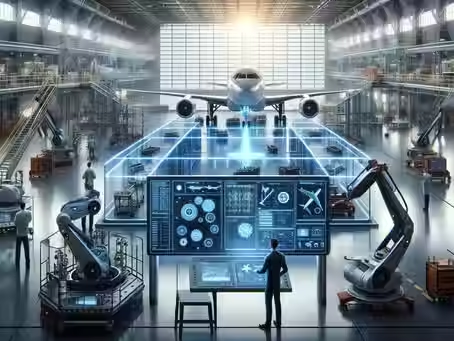
In the aviation industry, digital transformation is not just an option—it’s a necessity. Airlines, MROs (Maintenance, Repair, and Overhaul organizations), and parts suppliers manage thousands of moving components, from spare parts and maintenance schedules to customer relationships and financial operations. To stay efficient and profitable, businesses rely on specialized software systems like ERP, MRO, and CRM and supplement them with other specialized software programs.
While these platforms may seem similar at a glance, each serves a distinct purpose within aviation operations. Understanding how they differ—and how they work together—is key to maximizing efficiency, safety, and profitability.
1. ERP, MRO, CRM and Other Software — An Overview
Let’s start by defining each type of software in simple terms before exploring their differences and roles in aviation.
ERP (Enterprise Resource Planning) Software
ERP software serves as the central nervous system of a business. It integrates core business functions—such as finance, inventory, procurement, human resources, and logistics—into a single unified system.
In aviation, ERP platforms like Ramco® Aviation ERP, IFS®, or SAP® help manage everything from spare parts inventory to purchasing and accounting.
Purpose: To manage and streamline all internal business processes. Primary Users: Finance teams, inventory managers, procurement officers, and executives. Key Outcome: Operational efficiency and resource optimization.
MRO (Maintenance, Repair, and Overhaul) Software
MRO software focuses specifically on aircraft maintenance operations. It ensures every aircraft, component, and system is maintained according to regulatory requirements and performance standards.
Platforms such as Pentagon 2000®, Quantum-MX®, LogMRO®,, AvSight® or WinAir® are designed to track maintenance schedules, manage parts, log inspections, and ensure compliance with aviation authorities.
Purpose: To maintain aircraft health, safety, and operational readiness. Primary Users: Maintenance planners, engineers, and operations teams. Key Outcome: Improved reliability, compliance, and reduced aircraft downtime.
CRM (Customer Relationship Management) Software
CRM systems are designed to manage customer interactions, sales, and communication. In aviation, CRM tools help MRO providers, suppliers, and OEMs (Original Equipment Manufacturers) nurture client relationships, manage quotes, and improve service delivery.
CRM software—like Salesforce®, HubSpot®, or aviation-specific tools—stores contact details, tracks communications, and helps sales teams manage opportunities and client satisfaction.
Purpose: To strengthen customer relationships and boost sales. Primary Users: Sales, marketing, and customer service teams. Key Outcome: Better client engagement and increased revenue.
Other Software
ERP, MRO and CRM systems are designed for specific purposes and manage most of the functions for the type of company that uses them, However, they don’t do it all and specialized software is often required to complement the major solution. Everything from Word processing to Email to CAD systems to Spreadsheets to Accounting software is often used alongside or integrated with one of the major systems. Third party applications are used to fulfill specific needs in the company.
As an example an MRO system like LogMRO will often be coupled with an Accounting system. Or a CRM system will be coupled with quoting software such as AIquote.
Purpose: To supplement the functionality not provided by the major corporate system. Primary Users: Most staff will use one or more supplemental systems. Key Outcome: Greater productivity through specialized programs.
2. Core Differences Between ERP, MRO, and CRM in Aviation
Although these systems sometimes overlap, their focus areas differ greatly. Here’s a breakdown of their fundamental distinctions:
Feature | ERP Software | MRO Software | CRM Software |
Primary Function | Manages business processes and resources | Manages maintenance, repair, and compliance | Manages customer data and relationships |
Focus Area | Finance, procurement, inventory | Aircraft maintenance and operations | Sales, marketing, and customer support |
Users | Management, finance, procurement | Engineers, maintenance planners | Sales and customer service teams |
Key Metrics | Cost efficiency, resource use | Aircraft uptime, maintenance accuracy | Customer satisfaction, sales growth |
Integration Role | Acts as the business backbone | Ensures airworthiness and compliance | Drives business development and retention |
Each system serves a different operational layer—but when connected, they create a holistic aviation ecosystem.
3. ERP Software in Aviation: The Backbone of Operations
Aviation companies rely heavily on ERP software to manage resources, costs, and compliance across departments.
Key ERP modules include:
● Inventory & Procurement Management: Tracks spare parts, tools, and supplies across warehouses.
● Financial Management: Automates billing, payroll, and budgeting.
● Supply Chain Coordination: Links procurement and logistics to ensure timely parts availability.
● Regulatory Compliance: Tracks documentation for FAA, EASA, or other regulatory standards.
An ERP ensures that no resource—whether human, financial, or material—is wasted.However, traditional ERP systems are data-heavy and often lack real-time intelligence, which is where AI-powered solutions like LogMRO or AIquote complement them by introducing automation and analytics.
4. MRO Software: The Engine of Aircraft Maintenance
The aviation industry’s safety standards depend on precise, timely, and traceable maintenance. MRO software ensures that every maintenance action—from a part replacement to a full overhaul—is logged, scheduled, and approved according to aviation regulations.
Core functions include:
● Maintenance Planning & Scheduling: Preventive maintenance based on flight hours or cycles.
● Work Order Management: Tracks repair tasks from initiation to completion.
● Parts Tracking: Monitors the lifecycle of every component.
● Regulatory Compliance: Ensures all records meet EASA/FAA standards.
● Performance Reporting: Helps predict when maintenance will be required.
While ERP focuses on business efficiency, MRO systems focus on aircraft reliability and safety. Hence, most aviation companies that concentrate on aircraft maintenance will rely more on an MRO system than an ERP system. However, MRO tools alone can’t manage customer relationships or automate quoting — which limits their commercial potential.
5. CRM Software: Turning Aviation Relationships Into Revenue
In aviation sales, relationships drive business. Whether it’s parts supply, maintenance services, or lease agreements, customer trust and communication are key.
CRM systems make this possible by centralizing client information, sales activities, and communication histories.
Key CRM benefits include:
● RFQ Tracking: Manages and prioritizes requests from customers.
● Pipeline Management: Tracks potential deals and opportunities.
● Customer History: Stores past communications, purchases, and preferences.
● Automation: Sends follow-up reminders and quotes automatically.
● Performance Insights: Monitors sales performance and client satisfaction.
In the aviation context, a CRM bridges the gap between technical operations (MRO) and business management (ERP), ensuring that customer relationships lead to growth.
6. The Power of Integration — When ERP, MRO, and CRM Work Together
Each of these systems excels in its domain—but the true power comes when they work together.
An integrated ERP-MRO-CRM ecosystem gives aviation businesses:
● End-to-End Visibility: From part procurement to customer delivery.
● Seamless Data Flow: Maintenance data updates inventory and finance automatically.
● Faster Decision-Making: Executives get real-time insight into performance and profitability.
● Improved Customer Experience: Sales teams can access accurate maintenance and inventory data instantly.
● Regulatory Compliance: Every step is traceable and auditable.
For example, when a customer requests a quote for an aircraft component:
● The CRM records the request.
● The MRO system such as LogMRO, checks part availability and maintenance status.
● The ERP updates cost and financial impact.
● AIquote, as an intelligent add-on, automates pricing and sends the quote within seconds.
This synergy is what defines the next generation of aviation software.
7. The Role of AIquote in the Modern Aviation Tech Stack
While ERP, MRO, and CRM systems form the foundation, they often require manual input and coordination. This slows response times and creates inefficiencies in quoting and sales operations.
That’s where AIquote brings innovation.
AIquote is an intelligent automation platform that integrates seamlessly with ERP, MRO, and CRM systems to deliver:
● Automated RFQ Processing: Reads emails, extracts data, and creates quotes instantly.
● AI-Based Pricing Intelligence: Uses data from ERP and MRO systems to determine optimal pricing.
● Smart Prioritization: Routes complex RFQs to sales teams while handling simple ones autonomously.
● Data-Driven Insights: Analyzes patterns across systems to recommend profitable strategies.
By bridging the operational and commercial gaps, AIquote transforms the traditional aviation workflow into a smart, automated, and data-driven process.
8. Common Challenges Without Integration
Aviation companies using standalone ERP, MRO, or CRM tools often face these challenges:
● Data Silos: Systems don’t share information effectively.
● Manual RFQ Handling: Sales teams spend hours reading and responding to quotes.
● Inconsistent Pricing: Lack of data alignment leads to errors or missed profits.
● Slow Decision-Making: Without unified dashboards, managers can’t act quickly.
● Compliance Risks: Disconnected records increase audit and safety risks.
Integration with intelligent automation tools like AIquote eliminates these bottlenecks—allowing aviation businesses to scale faster and operate smarter.
9. Choosing the Right Software Mix for Aviation
Every aviation company is unique—what works for an MRO might differ for a supplier or airline. The key is to choose a combination of systems that address both technical operations and business growth.
For MROs: Use a strong MRO software integrated with ERP for materials and compliance, plus AIquote to handle quotes automatically.
For Aviation Suppliers: Combine ERP (for inventory and finance), CRM (for customer management), and AIquote for quoting automation.
For OEMs and Lessors: Pair ERP for financial management with CRM for client relationships and analytics tools for predictive maintenance.
In every scenario, AIquote complements these systems by removing manual work, improving accuracy, and accelerating sales cycles.
10. The Future of Aviation Software — Connected, Intelligent, and Automated
The next era of aviation technology is about intelligent connectivity. While ERP, MRO, and CRM software handle their core functions well, their real potential is unlocked when paired with AI and automation.
The future aviation ecosystem will look like this:
● ERP: Tracks resources and costs in real-time.
● MRO: Predicts and schedules maintenance using predictive analytics.
● CRM: Delivers personalized customer interactions based on live data.
● AIquote: Automates the quoting process and leverages intelligence across all systems.
This convergence will drive faster operations, higher profitability, and a superior customer experience — key advantages in a competitive aviation market.
Conclusion: Understanding the Difference, Embracing the Synergy
ERP, MRO, and CRM systems each serve unique purposes within aviation:
● ERP manages business efficiency.
● MRO ensures aircraft reliability and safety.
● CRM builds relationships and drives sales.
But when integrated and enhanced by AI-powered platforms like AIquote, they evolve from standalone systems into a smart, unified ecosystem that learns, adapts, and grows with your business.
The aviation industry is no longer about working harder—it’s about working smarter. And understanding how ERP, MRO, and CRM differ—and how they connect—is the first step toward building an intelligent, automated, and future-ready operation.
Comments